


In defense of Integrated Information Theory (IIT)
Reading | Neuroscience
 Bernardo Kastrup, PhD, PhD | 2023-09-27
In what may come as a surprise to many, our Executive Director highlights the careful, scientifically laudable metaphysical agnosticism of IIT—the leading neuroscientific theory of the structure of consciousness—as well as its superiority to alternative theories and synergy with Analytic Idealism.
In recent days, the world of neuroscience has been shaken by an open letter—signed by several neuroscientists and philosophers of mind—claiming that the Integrated Information Theory (IIT) of consciousness is pseudo-science. The shock effect of this letter is due to the fact that IIT has been considered the leading theory of consciousness in neuroscience for many years now, being supported by big names such as Christof Koch and Giulio Tononi. The ensuing brouhaha has been covered by my friend John Horgan here.
Rush to judgment?
I, too, criticized IIT as a physicalist account of consciousness in a couple of paragraphs of my book, Why Materialism Is Baloney, written well over a decade ago. My point was that no amount of information integration could explain the magical step of a fundamentally unconscious system suddenly becoming conscious. My thoughts on this specific claim did not change: IIT cannot account for consciousness under physicalist premises; it does not explain how an otherwise unconscious substrate can light up with consciousness just because re-entrant loops of information integration form in neuronal activity.
Since 2017, however, I have been discretely looking more closely into IIT. I have realized that, while there are enough physicalists out there claiming that IIT may offer an emergentist account of consciousness, the theory itself can be very straightforwardly interpreted as being metaphysically neutral, agnostic. As a matter of fact, the language used by the neuroscientists developing the theory is clearly and deliberately chosen so as to precisely avoid metaphysical commitments. Giulio Tononi, for instance, avoids equating experience with the neuronal substrate. Instead, he speaks of an “explanatory identity” between experience and the information structure IIT can derive from brain activity.
Note the carefulness and rigor here: the identity in question is explanatory, not ontic or metaphysical. It means that the information structure derived by IIT from patterns of brain activity can inform us about the qualities and dynamics of experience; it does not commit IIT to any position regarding the nature or origin of experience. When it comes to free will, Tononi also talks about “operational determination”: it is the information structure reflected by brain activity that determines our conscious choices, not necessarily brain activity itself. These word choices may seem obscurantist for their nuance, but they embody scientific clarity, honesty and rigor: good science is science done without metaphysical commitments, no matter how popular those commitments may be. IIT is good science, unshackled by unexamined physicalist prejudices.
Therefore, while I still stand by the letter of my original criticism of attempts to use IIT as an emergentist, physicalist account of consciousness, I realize now that I was unfair in spirit. And for that I offer my sincere and heartfelt apology to Giulio, Christof, and all the folks laboring to develop IIT as a scientific theory—as opposed to a metaphysical claim. Again, in my view, IIT is good science; even the best science, as far as attempts to study consciousness via objective methods are concerned.
The power of IIT
It is extraordinary—even appalling—how neuroscience regularly ignores experience in its attempts to explain, well, experience. For instance, a team at the Imperial College London has been attempting to account for the psychedelic experience with a minuscule increase in brain noise (i.e., desynchronized patterns of brain activity) observed during the psychedelic state. Such a hypothesis would be a little less absurd if the psychedelic experience felt like watching faint TV static. Alas, anyone who has ever had a psychedelic experience knows that this isn’t quite the case.
Science is an objective method of knowledge pursuit, and this is its key strength. Therefore, scientists should by and large avoid subjective approaches. But when it comes to consciousness, the very thing we are trying to account for is subjectivity itself. Therefore, while attempting to account for consciousness we cannot ignore, well, what consciousness is. This is so obvious it’s embarrassing to have to argue for it. In attempting to account for anything we cannot ignore the properties of that which we are trying to account for; experience is no exception.
And here IIT shines, for its key tenet is to stay true to what experience is. Its five axioms are derived from direct introspective access to experience and its properties. The theory is then built upon these axioms, as any theory of consciousness worthy of being taken seriously must do. A theory of consciousness cannot ignore consciousness in its attempt to account for it.
Beyond this, IIT provides a rigorous conceptual and mathematical framework, based on information theory, which allows us to model experience and derive experiential implications from observed patterns of brain activity. It can do so because there is an obvious correlation between felt experience and brain function; no serious scientist or philosopher would deny that. And such a correlation is all that IIT needs: it creates a layer of abstraction—the ‘phi structure,’ or sometimes the ‘causal structure’—derived from brain activity, which can then be translated into experiential implications. IIT creates a two-way map between the characteristics of felt experience and patterns of brain activity, in a metaphysically neutral manner—the hallmark of good science.
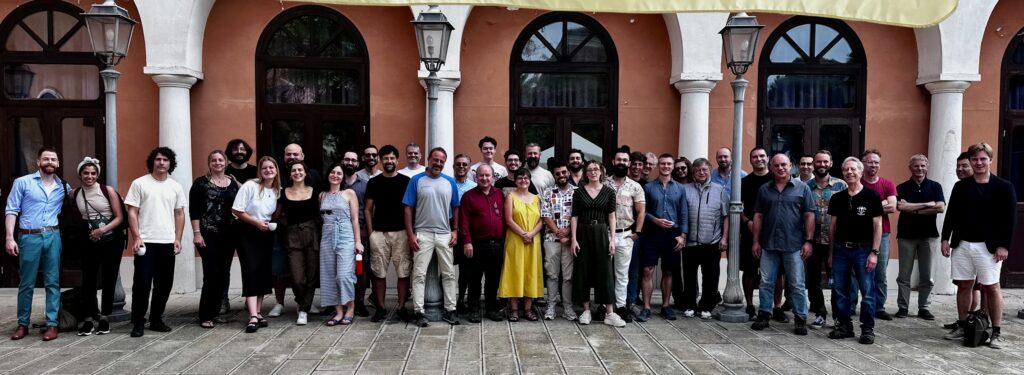
Part of the merry crew in San Servolo, Venice, during the Advanced School of Neuroscience, IIT meeting in September 2023.
IIT and Analytic Idealism
A couple of weeks ago, I spent a full week—literally all mornings, afternoons and evenings—in the small island of San Servolo, in the Venice lagoon, with Giulio, Christoph, and several other IIT researchers and students, discussing IIT. I was given the opportunity even to present my views on Analytic Idealism and its relation to IIT. I’ve learned a lot during that week, at both technical and personal levels, and I am very grateful to Christof and Giulio for that opportunity.
San Servolo congealed in my mind something that had been growing in it since 2017: that IIT complements Analytic Idealism extremely well. Through the process of “exclusion,” mathematically formalized in IIT, we could develop the first rigorous conceptual account of dissociation in psychiatry. Just such an account is the missing element of Analytic Idealism, for the latter postulates dissociation as the solution to the so-called ‘decomposition problem’ of idealism.
Moreover, the abstracted “phi” or “causal structure” IIT constructs is, under Analytic Idealism, our first model of the structure and dynamics of experiential states as they are in themselves, as opposed to how they appear to external observation. The latter is what we call ‘matter.’ While matter is the “phenomena” of Kantian terminology, experiential states are the Kantian “noumena.” IIT provides the first scientific model of the noumena, as opposed to the phenomena. The significance of this cannot possibly be overstated.
Notice that physics—the basis of all sciences—is purely a science of phenomena: a science of the contents of perception. In Kantian terminology, physics does not—and fundamentally cannot—describe nature as it is in itself, but just as it appears to observation. Physics is not—and cannot be—a science of the noumena. But IIT can. The abstracted phi structures of information integration are, under Analytic Idealism, the structure of nature as it is in itself—i.e., the structure of irreducible experiential states.
I thus regard IIT not as an enemy of Idealism, but precisely as one of its most important scientific complements and most promising partner for future theoretical and practical developments. This doesn’t mean that IIT is an idealist theory; it isn’t, and shouldn’t be, for science must remain metaphysically neutral. Philosophers, on the other hand, must precisely not be metaphysically neutral, for doing metaphysics is our job. And as it happens, metaphysics must be informed by science, since any metaphysics that contradicts established science is just wrong. It is in this sense that I see great promise in work that brings together IIT and Idealism: IIT can inform Idealism in a mathematically precise manner that Idealism has so far lacked (except for the work of Donald Hoffman and his team, which offers a different take on the formalisms).
The open letter brouhaha
Which brings me back to the beginning of this essay: the open letter claiming that IIT is pseudo-science, due to its alleged failure to make testable predictions. The people developing IIT are in a much better position to answer this charge—if they choose to do so, which I’m not sure is the best course of action, for reasons I will soon discuss—than I am. But I will very briefly share my view in this regard.
IIT did make predictions; and they were successfully tested. For instance, a key prediction of IIT is that, because of their neuronal anatomy, more interconnected areas of the brain should be more tightly correlated with conscious experience than the pre-frontal cortex. This is counterintuitive, since most neuroscientists thought that precisely the pre-frontal cortex was the seat of consciousness. Tests revealed IIT’s prediction to be correct.
There are other studies that I could allude to, but my point here is just to not concede the charge that IIT hasn’t made testable predictions; it has. However, even if it hadn’t, I think the pseudo-science charge made in the open letter betrays alarming ignorance of what IIT is and how it is progressing.
Indeed, IIT is trying to construct a map that allows us to infer the qualities of experience from the information structure of neuronal activity. We can create this map because we have access to both sides of the equation: we can measure brain activity and access experience through direct introspection. This double access allows us to calibrate or tune our models over time. We measure brain activity, feed those measurements into a mathematical model of the associated qualities of experience, and then check the output of the model against introspection. If the check fails, we refine the model and try again.
This calibration process requires foreknowledge of both sides of the equation: the measured patterns of neuronal activity and the corresponding introspective reports. Without this foreknowledge, no tuning can be performed and the model cannot be improved. No predictions can be done at this stage, for predictions entail precisely guessing an unknown side of the equation based on the other, known side. This, of course, can only be done once the calibration is complete and the model can be extrapolated to yet-unseen data.
Now, refining a model of experience—the richest, most nuanced, complex, and literally mind-boggling element of nature—in this manner is a titanic enterprise; there are countless variables and parameters at play, many of which are extremely hard to pin down through introspection. On the other side of the equation, measuring patterns of brain activity with the level of detail—resolution, granularity—required for the calibration is also exquisitely challenging. Let us keep in mind that functional neuroimaging is very recent: it’s a 21st-century thing, still in its infancy.
Because of this, to expect IIT to make a wide variety of concrete and testable predictions—i.e., to infer one side of the equation from the other with consistency and accuracy—at this point in the game is just naïve and unreasonable. That IIT has made testable predictions speaks to the resourcefulness of the researchers in question and should be considered a bonus. The timeline for having a consistent, reliable, extrapolatable model of the qualities of experience should be measured in decades, even in the best-case scenario of a theory that set out in the right direction.
All this aside, though, it strikes me as odd that academics should choose to criticize their peers’ work through an open letter. Academics typically use open letters to talk to the government or the public; not other academics. For the latter, the tool of communication is peer reviewed academic articles, not open letters. The use of an open letter is political, not scientific, and raises uncomfortable questions in my mind regarding the motivations.
Indeed, it is intriguing that, precisely as IIT makes an effort to be more explicit in its metaphysical agnosticism—through careful choices of words in the claims it makes—life-time activists of metaphysical physicalism, such as Daniel Dennett and Patricia Churchland, should choose to turn against it in a highly politicized move alien to academic custom.
Be that as it may, I considered it appropriate that I now broke my silence on IIT—which I have carefully maintained since 2017—and publicly voiced my support for it. Because IIT is good science, it doesn’t unthinkingly commit itself to physicalism. That this may have ruffled the feathers of physicalist activists is predictable, but their reaction is censurable, in my view.
Conclusions
IIT, far from contradicting Idealism, can in fact dovetail with it extremely well, in a synergistic combination that can finally allow us to: (1) develop a rigorous conceptual account of dissociation in psychiatry, possibly leading to new and desperately needed treatment protocols; (2) tackle the missing piece of Analytic Idealism by addressing the decomposition problem in a more explicit and rigorous manner, through the formalized notion of “exclusion” in IIT; (3) develop more effective treatment or palliative protocols for locked-in syndrome; (4) develop a no-report paradigm for the study of the neural correlates of consciousness, allowing us to finally overcome the severe limits imposed by metacognitive introspection; (5) possibly develop the very first theory of the noumena—as opposed to the phenomena—in the history of humanity; a theory of everything as it is in itself.
These are lofty prospects, with an unfathomable payoff. And in my view, no other theory of the structure and dynamics of experience comes anywhere near IIT in its rigor, clarity, formalisms, theoretical infrastructure, and insight. I see the open letter against IIT as a political move whose dubious motivations should have no place in academia. Finally, I look very much forward to cooperating with the IIT teams around the world in further exploring its synergies with Idealism.
Essentia Foundation communicates, in an accessible but rigorous manner, the latest results in science and philosophy that point to the mental nature of reality. We are committed to strict, academic-level curation of the material we publish.
Recently published

|
Prof. Moreira argues that reason cannot generate intrinsic value; it merely operates on existing human needs and emotional commitments. While reason can expose contradictions, refine desires, and structure society, it cannot logically compel anyone to care about existence, honesty, or reciprocity. True human value begins with felt needs—most fundamentally, the recognition of the “Other” and their inner life. Ultimately, reason and need must work together to build a pluralistic society where individuals can coexist without needing universal agreement on what makes life meaningful.

|
Dr. Goodwin argues that, under Idealism, all illnesses, not only mental health conditions, are a result of abnormal dynamics in the medium of mind. This includes infections, cancers, and even broken bones. The implications, he argues, open up new horizons for the expansion of effective treatment strategies, provided that we find ways to keep the nonsense—such as considering all illnesses merely psychosomatic—away.
From the archives

|
David Lloyd returns with another captivating analysis of the isomorphisms—the correspondences of form—between the patterns and regularities of inner experience and those of the physical world. His writing is informed by both deep introspection and hardcore physical science. In this essay, he discusses isomorphisms that allow teleology—a certain sense of purpose and direction—to exist in nature in a spontaneous, science-treatable manner, without need for deliberation from an anthropomorphic divinity.

|
Brian Stafford, MD, is a psychiatrist, board member and training director at the Animas Valley Institute, the organization founded by depth psychologist Bill Plotkin PhD and known for its work on nature-based human development. In this conversation with Hans Busstra, Stafford reflects on his remarkable transition from a successful academic career in psychiatry to guiding wilderness-based practices aimed at what he calls an “eco-awakening”: a shift from an ego-centric to an eco-centric mode of consciousness.
Drawing on the work of Plotkin, Carl Jung, and his own clinical and personal experience as a wilderness guide, Stafford argues that many forms of psychological suffering are rooted in a deeper ecological disconnection. Rather than viewing the psyche primarily through the lens of pathology and symptom reduction, he proposes that psychiatry should recover a richer understanding of the psyche as a living reality embedded within both nature and the symbolic life of dreams, imagination, and meaning.

|
Through a simple, direct, and very effective thought experiment, Nilsson helps us develop a very concrete and explicit understanding of where events take place: the realm of mind. He further demonstrates the fundamental independence between this realm and spatial location.
Reading
Essays

|
Renowned physicist and nanoscientist Anirban Bandyopadhyay presents a radically different picture of the human brain: not as a computer processing bits, but as a nested architecture of clocks, resonances and shifting geometric patterns. At Japan’s National Institute for Materials Science (NIMS), Bandyopadhyay and his team developed the dodecanogram, or DDG: a high-frequency brain-measurement technique designed to detect electrical and electromagnetic activity far beyond the reach of conventional EEG. Their findings include megahertz signals associated with microtubules, structures inside neurons that may host quantum effects. This research leads Bandyopadhyay to view consciousness quite literally as a universal symphony making music that is both everywhere and nowhere. Yet, while unequivocal in rejecting the computational view of consciousness, he remains cautious about the implications of his own findings: “The time has not yet come for a true theory of consciousness.”

|
In this short and accessible essay, Karina Firme uses an idealist metaphysics to explain why integrating rejected aspects of our own personalities discharges the emotional load we normally associate with other people, thereby quietening the world. Her ideas offer a compelling example of the explanatory power of metaphysics: of how it can both elucidate and ground facts of clinical observation that, although described, couldn’t be quite explained before.
|
David Lloyd returns with another captivating analysis of the isomorphisms—the correspondences of form—between the patterns and regularities of inner experience and those of the physical world. His writing is informed by both deep introspection and hardcore physical science. In this essay, he discusses isomorphisms that allow teleology—a certain sense of purpose and direction—to exist in nature in a spontaneous, science-treatable manner, without need for deliberation from an anthropomorphic divinity.
|
Brian Stafford, MD, is a psychiatrist, board member and training director at the Animas Valley Institute, the organization founded by depth psychologist Bill Plotkin PhD and known for its work on nature-based human development. In this conversation with Hans Busstra, Stafford reflects on his remarkable transition from a successful academic career in psychiatry to guiding wilderness-based practices aimed at what he calls an “eco-awakening”: a shift from an ego-centric to an eco-centric mode of consciousness.
Drawing on the work of Plotkin, Carl Jung, and his own clinical and personal experience as a wilderness guide, Stafford argues that many forms of psychological suffering are rooted in a deeper ecological disconnection. Rather than viewing the psyche primarily through the lens of pathology and symptom reduction, he proposes that psychiatry should recover a richer understanding of the psyche as a living reality embedded within both nature and the symbolic life of dreams, imagination, and meaning.
|
Through a simple, direct, and very effective thought experiment, Nilsson helps us develop a very concrete and explicit understanding of where events take place: the realm of mind. He further demonstrates the fundamental independence between this realm and spatial location.
Seeing
Videos

|
Steven Wolfram claims that the “ruliad,” the space of all possible computational states in nature, is reality—a structure so complete it contains every possible way of processing information. Our universe emerges from how observers with particular computational bounds sample this infinite structure. In this profound essay, Proulx argues that the ruliad is best understood under an idealist framework wherein each observer’s perspective isn’t merely a partial representation of underlying states, but a rendering of reality itself; just as a frame in a computer game is a rendering generated on-the-fly, not a partial representation of underlying states.

|
In this conversation, cognitive scientist John Vervaeke joins Hans Busstra to examine the historical roots of the modern meaning crisis through the lens of psychotechnologies: culturally developed mental tools and practices that transform how human beings think, perceive and make sense of reality. Vervaeke describes how psychotechnologies such as shamanism, Socratic dialogue and the Christian notion of agape profoundly shaped Western thought.

|
In less than 2000 words, Brian Fang shows that ‘substance’ does not define existence; structure does. What a thing is cannot be separated from the structure that remains stable as everything else changes, particularly at the quantum level. If we look closely at what things actually are, we cannot help but realize that they are far removed from our classical intuition of mere blocks of “stuff.” Instead, to understand an object is to understand its specific pattern of invariance.
Let us build the future of our culture together
Essentia Foundation is a registered non-profit committed to making its content as accessible as possible. Therefore, we depend on non-financial contributions from people like you to continue to do our work.