

The circle dance of personal identity
Reading | Philosophy
 Ola Nilsson, MA | 2025-02-14
Philosopher Ola Nilsson is back with another one of his mind-boggling, and yet irresistibly compelling, thought experiments. This time he shows, with surprisingly few words, how one universal mind can appear to be many, such as you and I, simply because of time and will. Buckle up for this amazing ride!
Introduction
This essay is a standalone continuation of my previous essay, Meta-Survival: On the Incoherence of Localized, Countable Subjectivity. This time, I aim to clarify what the perceived dissociation between us consists of and to answer the question of why you are not me. I may fail in this task, but by the end of my investigation, I will have deduced a new question on this theme. This question may at first glance seem trivial, but as we will see, its answer seems to hold the key to why we are dissociated from one another.
The circle dance
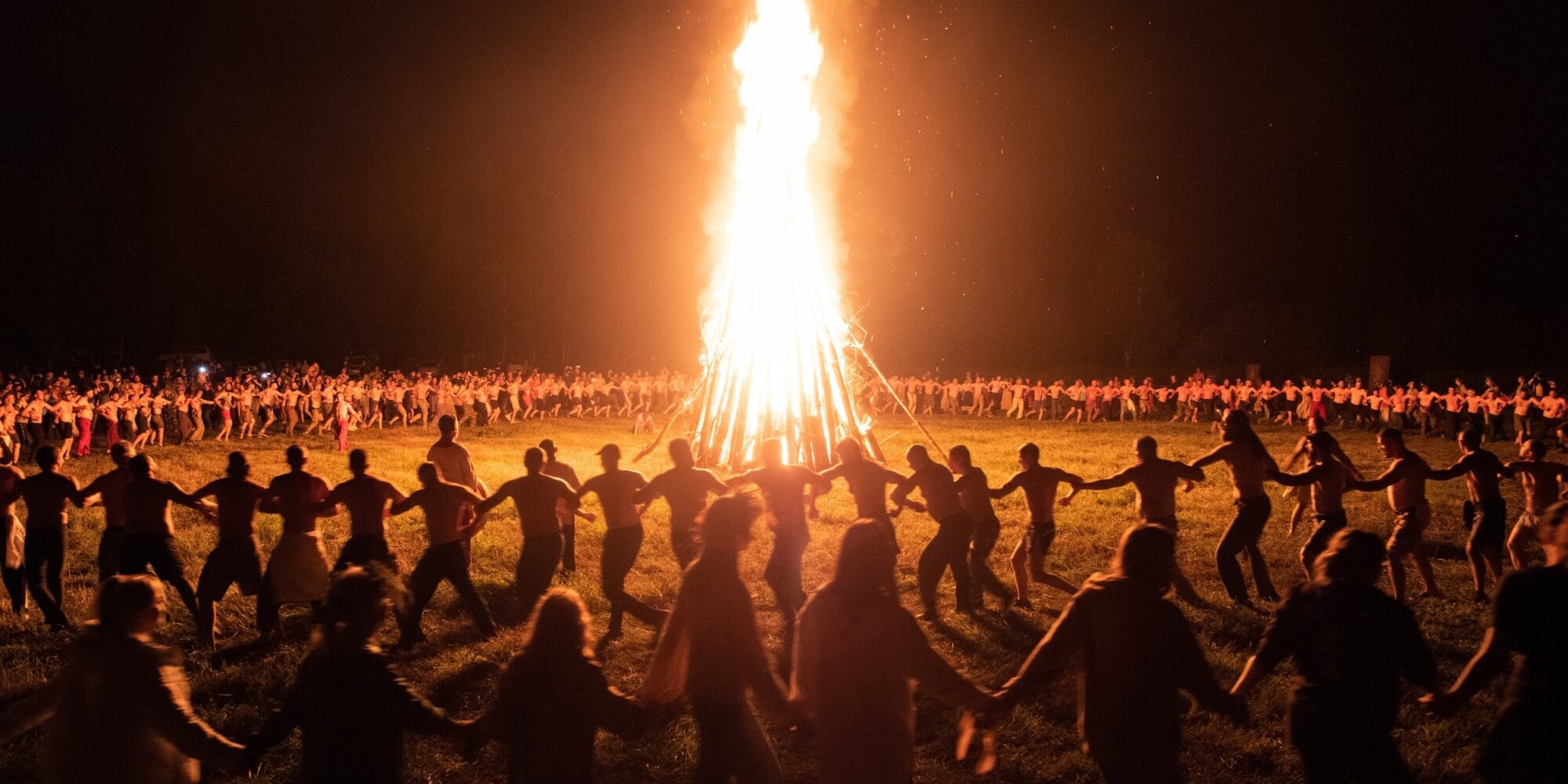
If you found yourself in a circle with three other people, identical to you in every way, in an otherwise empty universe, which of these individuals’ perspectives would be yours? In this scenario, my position is that there would only be one first-person perspective, one personal mind—and it is yours. You constitute all these ‘four’ persons. How do I justify this claim? Simply because in this scenario, there is nothing that differentiates you from the others; you are all the same. If this thought sounds bizarre, I recommend you read my previous essay.
Now, the following scenario unfolds in the circle (see Figure 1): You, denoted as person A, raise your right hand (i.e., persons A, E, I, and M raise their right hands in sync). Then you, now denoted as person B, raise your left hand (i.e., persons B, F, J, and N raise their left hand in sync). Next, you, now denoted as person C, start walking to the left (i.e., persons C, G, K, and O start walking to the left, in sync). What I’ve described now is your performing a kind of dance. No dissociation has yet occurred; you’re just doing a dance.
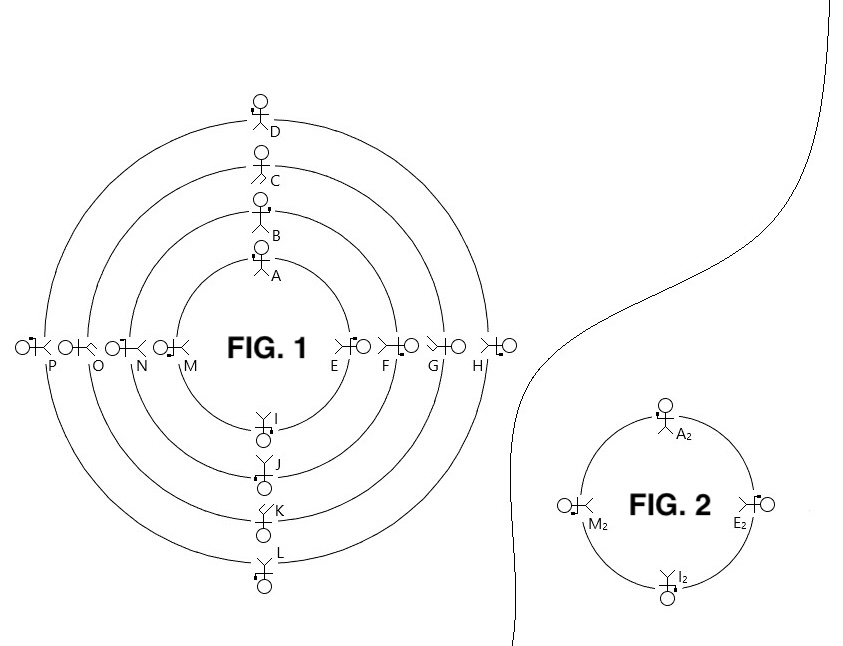
In the critical moment of the final dance step, however, imagine that you, now denoted as person D, raise your right hand while observing that the other three (persons H, L, and P) are raising their left hands. This breaks the symmetry, and you all now have, by necessity, different perspectives. Dissociation has occurred. You are now one of four unique, distinct individuals.
But now notice that the exact same kind of dissociation has already occurred among the four situations shown in A, B, C, and D (or, if you prefer, among E, J, O, and D, etc.) as when you raised your right hand instead of your left. What distinguishes A, B, C, and D is time. What distinguishes D, H, L, and P is simply that they are different persons. For this statement to make sense, we need to discuss what time is.
Time and time loops
Visualize a marble-run in which a marble moves around in circles. There is nothing more in the world than this system: the marble-run and the marble. Now imagine that the marble-run is ‘magical’ in the sense that, when the marble completes one round, it and the marble-run are restored precisely to their original states, so the marble keeps on going round and round.
Let’s now enter the scene in person and observe the marble going around the marble-run ten times—that is, you watch the marble go around ten times. You are now a witness: you counted. However, note that you are not restored to your initial state after each marble round. You are necessarily in different states as you count the marble’s rounds. This way, it’s perfectly reasonable to think of yourself, the marble, and the marble-run as one system in which time has moved forward. Remember that you counted ten rounds, and this will take some time. In this system, the marble-run and marble will necessarily be affected by your presence. You will, for example, emit heat and exert a gravitational influence on the entire system while you count, which means that the marble run system cannot be perfectly restored after each round as when you were not present.
If we remove you from the system, leaving only the marble-run and the marble, we can ask ourselves what it means that the marble has done ten rounds, given that the system is restored exactly to its original state after each round. I argue that it doesn’t mean anything to claim that the marble has done ten rounds, any more than to claim that the marble has done one round or a billion rounds. This is because there is nothing in the world that can tell these rounds apart.
An easier way to look at this is to imagine yourself in a situation where you are on your way home, but in the middle of the street, an evil demon is waiting for you and tricks you into a loop. He makes you do the walk a hundred times but restores your state each time in the same way as described for the marble-run. After the hundredth time, he lets you through, and you reach your home. Do you think your situation and world would be any different if the demon hadn’t played this trick on you? If so, you have some explaining to do.
It is not time that changes the system; instead, it is the change of the system that gives rise to what we perceive as time. If the system is perfectly restored to its initial condition after each round, no ‘before’ would exist, because time is then literally restored. And if we restore time, we can’t really talk about a time before the restoration of time. It would be a logical monstrosity to do that.
Does the statement above mean that I am defending logical positivism, the notion that statements are meaningful only if they can be empirically verified or are analytically true? Definitely not. What I’m saying is just that the claim that the described event has occurred ten or a hundred times is neither meaningless nor meaningful. The question lacks relevance in this context. Remember that we literally have restored time after each round, and after each of your attempts to get home! Or do you think you can reset time in time? If so, you end up in an infinite regress. Note that I’m not claiming that time is an illusion or that time doesn’t exist; I’m simply stating that time and change are the same thing.
As shown above, time appears and presents itself differently depending on the instantiated system. This means that the very same circle dance described earlier could be played out in an identical system (see Figure 2), but this will never take place in a different time, because it is the very same time that arises in this system.
But what about the geographic location then: isn’t that different? This question, too, seems to lack relevance. If we accept that A, E, I, and M are the very same person as stated before, nothing in the world would be different if it were instead A, E2, I2, and M we found in the first ring.
Am I contradicting myself now, since I spoke earlier of how you inevitably affected the marble-run with your presence? Shouldn’t these two systems (the rings in Figures 1 and 2) affect each other in the very same way? Yes, if we believe in spacetime and if they were close. But we can resolve this problem by placing these ‘two’ systems so far away from each other that their respective light cones are inaccessible from each other, and the problem is solved.
Dissociation
If time and change are the same thing, it means that A, B, C, and D on the one hand, and D, H, L, and P on the other, are dissociated under exactly the same conditions. This, in turn, means that A represents a certain person, B represents another person, G represents a third person, and so on. Persons B and C are not the same person, for the same reason that D and H aren’t. Yes, there may be a ‘memory connection’ from D back ‘in time’ to C, B, and A, but this doesn’t mean that A, B, C, and D are the same person. I would argue that D is more dissociated from A than H, since A to D involves more steps of change compared to D to H.
Does this knowledge provide us with new insight into fission cases where one person splits into several persons, like in the case with D, H, L, and P? Remember that the question “Which of D, H, L, or P is actually you?” bears the same kind of answer as the question “Which of A, B, C, or D is actually you?” If we can answer one of these questions, we have answered the other question as well.
Which of D, H, L, and P is you is a question about personal identity, so let’s explore that further. As explained above, personal identity shouldn’t be viewed as a transitive relation and something unique that you carry throughout your life. Instead, we consist of myriads of identities through life. We can liken these identities to different ‘rooms’ that we can enter. Let us assume that person D claims that she is person D and wants to know why she is not person H. Why does she have this unique person D perspective? We understand the question. We also understand that C is defined by a unique room containing a unique identity that asks this question. It could not have been in any other way in this scenario, because if it were, the question would not have been asked by C.
If C so desires, there is nothing preventing C from transforming into another room, for example, H’s room. C then becomes H and, instead of asking questions about her existence, she will be doing something else. Several different rooms will need to be passed through by C to transform into H, but there is no reason to believe that C, in this continuous chain towards H’s room, would feel that she ceased to be herself, even when she enters H’s room and then becomes H. The question of which of D, H, L, or P you are is therefore a non-question, you are or were them all, in the same way that you are or were A, B, C, and D. Yet you are, at the same time, divided into myriads of rooms—or, if you like, identities.
Conclusion
In this essay, I argue that time is change, and that change inexorably leads to dissociation. Can the concept of dissociation be explained in further terms? Dissociation arose when you chose to lift your right hand instead of your left, just as when H, L, and P chose not to do so. Similarly, dissociation occurred at every moment of the dance for A, B, C, and D. Wasn’t it you who performed the dance with intent? And wasn’t it you who chose to lift your right hand?
If you can answer the question of why ‘you’ chose to lift your right hand at that critical moment at the end of the circle dance, then you have also answered why we are dissociated from each other. Or perhaps we should blame H, L, and P, who didn’t raise their right hands at the critical moment. Maybe it was something else that guided your or their movements? Regardless, dissociation seems to inevitably follow the same path as Will, whether it is your will, my will, or someone else’s Will.
Essentia Foundation communicates, in an accessible but rigorous manner, the latest results in science and philosophy that point to the mental nature of reality. We are committed to strict, academic-level curation of the material we publish.
Recently published
|
Does Analytic Idealism limit the scope of its own conclusions and implications because of its adoption of realist, empirically-focused, scientific concepts and argument structures? If so, can the notion of a meta-conscious (that is, self-aware, deliberate) universal consciousness be reconciled with it? Dr. Grego argues precisely so in this critical essay.
|
Hans Busstra and Dr. Lídia del Rio talk to Dr. Matthew Leifer, Assistant Professor of Physics at Chapman University, about the epistemic interpretation of quantum mechanics. Classically, when physicists call themselves ‘realists’ they mean that we should assume that a physical, observer-independent universe is fundamental. But if this counts as realism, anti-realism is perhaps the more respectable position. Leifer points, for instance, to ‘Bell-Wigner mashups’: thought-experiments that entangle different observers to arrive at disturbing consequences; for instance, that there is no ‘absoluteness of facts’ for all observers, in a classical sense.
From the archives

|
What if phenomenal consciousness, signs, communication, and interpretation are fundamental aspects of all living systems, whether or not we can detect brains? This is the departure point of biosemiotics, an interdisciplinary field that combines biology, semiotics (the study of signs and meaning), and philosophy. Environmental philosopher Dr. Yogi Hendlin is Editor-in-Chief of the Journal of Biosemiotics and, in this conversation, Hans Busstra talks to him about the widespread meaning-making in nature. All living beings, from bacteria to plants to mammals, have an ‘Umwelt,’ a dashboard representation of the world. In a sense, biosemiotics states that our mind is in the world: we are embodied beings, and with every inhalation 50.000 microbes enter our body, and they communicate to us by influencing our microbiome.

|
Professor Zaghi introduces Relational Quantum Dynamics (RQD), a further development of Carlo Rovelli’s Relational Quantum Mechanics (RQM) with a solid mathematical and metaphysical basis. RQD circumvents the infinite regress inherent to RQM (everything being constituted of relations between meta-relations, and these consisting of relations between meta-meta-relations, etc., ad infinitum) by proposing that, although all physical entities are indeed relational, the relations—and even spacetime itself—arise within an underlying field awareness.

|
Hans Busstra talks to Dr. Bernardo Kastrup about the groundbreaking work of Professor Michael Levin and Dr. Christof Koch. Levin’s research into bio-electric fields reveals that cellular networks use electrical signals not just for immediate physiological tasks, but to coordinate complex patterning and memory across tissues—suggesting a kind of distributed intelligence in living systems. Christof Koch, meanwhile, champions Integrated Information Theory (IIT), which proposes that consciousness is an intrinsic property of certain physical systems with high levels of causal interconnectivity. Both lines of inquiry challenge the traditional reductionist view that mind is merely an emergent byproduct of neural activity. Instead, they point to a more holistic, perhaps even fundamental, role for information and consciousness in nature. Though Levin and Koch make no explicit metaphysical claims in their work, their empirical findings and views are very much in line with analytic idealism.
Reading
Essays
|
Dr. David Schmid, Dr. Lídia Del Rio and Hans Busstra explore a metaphysical shift that’s happening in the foundations of physics: the wave function is no longer regarded as something real, but just as a description of what we know about the world. In philosophical terms: the wave function is not ontic, but epistemic. And in more popular terms: the multiverse is science fiction, resting on a too-literal interpretation of a piece of mathematics called the Schrödinger equation.
|
The jealous and alienating gnostic Demiurge, a certain mode of attending to the world described by Heidegger, and Iain McGilchrist’s characterisation of the brain’s left-hemisphere, all share remarkable similarities, according to Arthur Haswell. He suggests thus that the Demiurge may be a symbol of something that lives in us, modulating how we relate to others and the world at large. As such, the holistic perspective of the right hemisphere may be a corrective that brings us closer to the transcendent and truly divine.
|
What if phenomenal consciousness, signs, communication, and interpretation are fundamental aspects of all living systems, whether or not we can detect brains? This is the departure point of biosemiotics, an interdisciplinary field that combines biology, semiotics (the study of signs and meaning), and philosophy. Environmental philosopher Dr. Yogi Hendlin is Editor-in-Chief of the Journal of Biosemiotics and, in this conversation, Hans Busstra talks to him about the widespread meaning-making in nature. All living beings, from bacteria to plants to mammals, have an ‘Umwelt,’ a dashboard representation of the world. In a sense, biosemiotics states that our mind is in the world: we are embodied beings, and with every inhalation 50.000 microbes enter our body, and they communicate to us by influencing our microbiome.
|
Professor Zaghi introduces Relational Quantum Dynamics (RQD), a further development of Carlo Rovelli’s Relational Quantum Mechanics (RQM) with a solid mathematical and metaphysical basis. RQD circumvents the infinite regress inherent to RQM (everything being constituted of relations between meta-relations, and these consisting of relations between meta-meta-relations, etc., ad infinitum) by proposing that, although all physical entities are indeed relational, the relations—and even spacetime itself—arise within an underlying field awareness.
|
Hans Busstra talks to Dr. Bernardo Kastrup about the groundbreaking work of Professor Michael Levin and Dr. Christof Koch. Levin’s research into bio-electric fields reveals that cellular networks use electrical signals not just for immediate physiological tasks, but to coordinate complex patterning and memory across tissues—suggesting a kind of distributed intelligence in living systems. Christof Koch, meanwhile, champions Integrated Information Theory (IIT), which proposes that consciousness is an intrinsic property of certain physical systems with high levels of causal interconnectivity. Both lines of inquiry challenge the traditional reductionist view that mind is merely an emergent byproduct of neural activity. Instead, they point to a more holistic, perhaps even fundamental, role for information and consciousness in nature. Though Levin and Koch make no explicit metaphysical claims in their work, their empirical findings and views are very much in line with analytic idealism.
Seeing
Videos

|
“If experience is all I have, I may be alone—but the essential emotional necessity of the other demands that I live as if I am not,” argues Dr. Moreira in this heart-felt essay. He embodies a long-overdue reemergence of existentialist thought in the 21st century and, as an active and successful AI scientist, in 21st century terms. We think both the worlds of philosophy and popular culture will be hearing a lot more from Dr. Moreira in the coming years…

|
Dr. Edward Kelly, a professor of experimental psychology, talks about his many years of study of a variety of psi and anomalous phenomena. In this interview with Natalia Vorontsova, he candidly shares how phenomenological evidence has led him to re-examine his metaphysical views on the nature of reality. Are our minds confined to our brains? Do we survive our biological death? Is mind primary to matter? Why should we take anomalous phenomena seriously? These are some of the topics covered in this conversation.

|
Fredric Nord argues that knowing reality through language is fundamentally and inescapably a misunderstanding of reality. We misunderstand what language actually does and, thereby, misunderstand what life is. The key to understanding life is, he argues, a reframing of language and representation. This should end the paradigm of materialism and facilitate transcendence as a priori.
Let us build the future of our culture together
Essentia Foundation is a registered non-profit committed to making its content as accessible as possible. Therefore, we depend on contributions from people like you to continue to do our work. There are many ways to contribute.